


Hon Mercy Dinha
Deputy Minister of Public Service, Labour and Social Welfare
The roar of Victoria Falls provided a fitting backdrop for a gathering that may well redefine the future of child protection across Southern Africa. The Family Placement Conference 2026, hosted by the Government of Zambia in partnership with Care for Children, drew policymakers, civil society leaders, faith-based organisations, caregivers and youth representatives to strengthen family-based care systems and reduce reliance on institutional care. While Zambia played host, one of the most compelling voices came from Hon. Mercy Dinha, Deputy Minister of Public Service, Labour and Social Welfare of Zimbabwe, who spoke with conviction about her country’s transition from institutional care to family and community-based care.
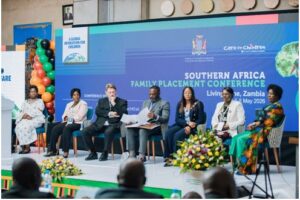
“It is my honour to address this conference on behalf of the Government of Zimbabwe as I extend my profound gratitude to the Government of Zambia, in partnership with Care for Children, for convening this historic conference dedicated to promoting family-based care and placement,” she said. Hon. Dinha shared striking statistics that underscored both progress and challenges in Zimbabwe. Of the nation’s 7.1 million children, including 562,872 orphans, only 4,500 remain in residential care and 660 in formal foster care. The vast majority over 95 percent are supported within extended family or kinship care systems. “This demonstrates the continued strength and need to build on our traditional systems of care in Africa,” she emphasised, reminding delegates that Zimbabwe’s constitutional and legislative framework guarantees every child the right to family or parental care. Residential childcare institutions, she explained, are expected to provide only temporary care while family reunification efforts are pursued, with greater emphasis on family-type care models that enhance children’s wellbeing and dignity. Zimbabwe’s leadership in digital reform was also highlighted. Hon. Dinha noted that platforms such as the National Case Management Information System are improving case tracking, strengthening data management, supporting continuous learning for child protection professionals, and enhancing accountability, efficiency and evidence-based decision-making. Her remarks reinforced Zimbabwe’s role as a regional leader in child protection reform, complementing Zambia’s introduction of My Family, a digital platform designed to modernize family placement systems. Hon. Dinha urged delegates to embrace solidarity and regional cooperation: “Together, let us strengthen regional cooperation, as we invest in resilient child protection systems and continue sharing knowledge and experiences so that no child in Africa is left behind. “The gathering in Livingstone was more than a policy dialogue. It was a reaffirmation that every child deserves to grow up in a safe, permanent and loving family environment. With Zimbabwe’s Deputy Minister Mercy Dinha championing family-based care and digital innovation, Southern Africa is poised to make family placement not just an aspiration but a reality.